Showing posts with label italy. Show all posts

Life lately


It has undoubtedly been a while. This year marks the end of my high school education and the step further into university. Understandably, between studying for my final exams and practicing for my acceptance exams, there was hardly any free time left. And whatever time I had had to myself I diligently spent reading or catching up with my tv series (as one does). With July 10th all my schoolwork was officially done, and I am now left to my own devices, waiting to see what my future is going to be starting October 1st. Either way, having 3 whole months on my hands is more than enough time to get back on track with my idea of blogging.

Plans for summer

As always, I am planning no less than two daytrips to Venice, one to see the Viva Arte Viva Biennale Exhibition, and one to further discover the backalleys of the magnificent city. I'd also quite like to take the vaporetto (water bus) to the neighboring islands, mainly San Michele (the cemetery, to see Joseph Brodsky's grave) and Burano. 
Sailing around the Croatian coast is always on the agenda, however it saddens me to say that I won't get to see Rovinj this summer, as a large proportion of its coastal area is under construction, the marina has been torn down in order to have a new one built instead.
To commemorate my matura, my sister and I have decided to discover new corners of Europe. In August, we will be spending a week in Scandinavia, discovering the countries by plane, boat and bus. As Paris is currently the furthest I have ever been from home, and have not yet stepped foot on a plane, saying that I am looking forward to this trip is more than an understatement. 
Last week I took a trip to Vrsar and the past Saturday was spent rediscovering Aquileia and Grado. In a similar sense I might just visit Verona and Vicenza this summer. 
Above and in spite of it all, I plan on reading the hell out of my books, as I have acquired quite a collection over the past two years, and the books are not going to read themselves.

Music

Around 6 months ago the Slovene radio staions started playing Kaleo's Way Down We Go. Sometime later I found Save Yourself and No Good, but it took me until June to really comprehend the wide range of music the Icelandic band offers. I can't recall the last time I bought an album in the physical form, but let me tell you, I didn't even hesitate when buying A/B. Anyways, it doesn't hurt to check out some of their music, in fact, I strongly encourage you to do that.

Current favourite song: I can't go on without you
(look at me slapping links everywhere I go)

Film and television

I went to see Spider-Man Homecoming the other day, I enjoyed the film very much, and am very happy it silenced the reboot skeptics.

I was left gobsmacked at the end of Doctor Who's season 10, and am very excited at the revelation of the 13th Doctor, Jodie Whittaker!
As a fan of both Sherlock and Doctor Who, it was only a matter of time before Supernatural came to drag me into the ninth circle of hell, also known as Superwholock. In other words: I started watching Supernatural. To be completely honest, I take this to be one of my more stupid decisions, given that I can't handle anything remotely scary, and that I have 12 seasons worth of catching up to do. Nevertheless, I'm at the end of season 2 and have only had one nightmare, so I have my fingers crossed it stays that way. The series definitely did surpass my expectations, as once you get over the initial fear of all things unholy, you realise it's actually a very funny show with some dramatic elements and a great amount of action.

Books

The last two weeks had me in turbo reading mode, I managed to read Ray Bradbury's Fahrenheit 451, George Orwell's 1984, and Clarice Lispector's Agua Viva.

This summer I'm set to read the following books:
Evelyn Waugh - Labels
Henry Miller - The Colossus of Maroussi
Thomas Hardy - Two on a Tower
Brian Clegg - A Brief History of Infinity
F. S. Fitzgerald - The Beautiful and Damned
Virginia Woolf - Mrs. Dalloway
Bruno Munari - Design as Art

What will you be up to this fine summer?

x, Valens

Venice in winter


If there are any genuine readers of this blog, you may recall a review of Joseph Brodsky's collection of essays on Venice titled Watermark. What was at the very beginning just another book, quickly turned into an unidentified form of connection with the city of Venice. If travel were a religion, Venice would be the holy city, and Watermark would be the Bible. As it had been done in August, we arrived to the city by train in the early morning hours. The day couldn't have possibly begun without a caffeine fix, thusly the first stop was made in the café closest to the train station. First on the itinierary was Ca' Pesaro - the museum of modern and oriental art, which is situated in Santa Croce. There we took a look at various artworks from various periods such as Picasso, Kandinsky, Mirò, Dalì etc. Besides the permanent collection, there was also an exhibition of Coco Chanel titled The woman who reads. The collection consisted of various books, designs, letters, notes and notebooks. Aside from the art situated inside the palace, Ca' Pesaro could be a museum all on its own. It reminded me of Brodsky's words:

“This city doesn’t qualify to be a museum, being itself a work of art, the greatest masterpiece our species produced. You don’t revive a painting, let alone a statue. You leave them alone, you guard them against vandals, whose hordes may include yourself.”

When one strolls through the rooms, they encounter themselves in doubt as to what admire first. The floors are sheathed in somewhat subtle motifs, whereas the ceilings are endowned with depictions of biblical scenes, surrounded with an abundance of gold decorations. Undoubtedly an unmissable experience.

Afterwards, we continued past the Venetian market over Ponte Rialto towards Palazzo Contarini del Bovolo, where we purchased tickets to climb the spiral stairs. What makes this palace especially unique is its location, as it is hidden among multiple back alleys. In addition, Palazzo Contarini del Bovolo presents a great alternative for those unwilling to climb to the top of Campanile San Marco, as it offers a beautiful view of Venetian rooftops with various belltowers (along with Basilica San Marco) standing out. After having climbed the stairs and taken a look inside the Tintoretto room, we proceeded towards Piazza San Marco, along with a pit stop at La Fenice. Lastly followed a visit to the Querini Stampalia bookshop and the famous Acqua Alta, which was for me quite a disappointment. Afterwards, all stops we made were souvenir shopping and coffee drinking oriented. At 15.40, we boarded the train back to Trieste and called it a day.


Despite having visited the city of water for the fifth time, it still never ceases to amaze me. Walking through the streets, the traveler is overtaken with a sense of urgency, as it is a well known fact that the city is sinking, and we are thus running out of time to discover all its beauty. Nevertheless, it is foolish to encase oneself in worry, for it is important to enjoy Venice in all its wondrous glory instead.

Is Venice on your bucket list?

x, Valens


A day in Venice


The city of Venice is on the very top of the list of my favourite places in the world, along with Brioni islands, Rovinj, and Florence. The one advantage that I, as a Slovenian, have is the accessibility of the city, which I discovered about 2 years ago, when I was getting more into travel, and was left gobsmacked at all the possibilities sitting under my nose. Along with all the films and all the books taking place in Venice, which have the power to give anyone some serious wanderlust, I had made it mandatory to escape to Venice by train for a day. As it always is, my plans were put off until the very last day of summer, a turnout I didn't mind at all.

On August 31st at 6am, my sister and I boarded the train for Venice, and after a 2 hour long ride, we arrived to the Venezia Santa Lucia railway station. Anyone who has ever travelled to Venice by train knows that there are few things that live up to the initial view of the city when stepping outside the railway station. Some things never change, and one of them is the indescribable beauty of Venice. As we had been to the city many times before, it was not in our main interest to focus on the landmarks. Thus, we approached the city in a more relaxed manner, wandering the streets and worming our way through to see significant buildings that are either hidden in the web of water and stone, or best accessible by boat.

We began our wanderings by crossing Ponte degli Scalzi and continuing towards Ponte Rialto through the Santa Croce/San Polo 'neighborhood'. It is advisable to turn to the Fondamenta Riva Olio, from where you get a great view of Ca' d'Oro and the Grand Canal. From there we went on over the bridge to the market, past Ruga Orefici, and finally reached Ponte Rialto. Afterwards, we simply followed the signs, which lead us to Piazza San Marco, where we wanted to climb the Campanile (belltower). However, due to the lack of food and will, we decided to cross that off our list, and instead continue towards Dorsoduro, over Ponte dell'Accademia to a smaller square where we had a snack.

 Once all our primal needs were satiated, we visited Palazzo Venier dei Leoni, better known as the Peggy Guggenheim Collection. There we had our first encounter with Cubism and Abstract Expressionism, with paintings of great artists such as Kandinsky, Mirò, Dalí, Picasso, De Chirico, Mondrian etc. When that was done, we reverted back to our routine sightseeing and shopping. On our way back to Piazza San Marco, we took a beeline to see the theatre La Fenice and a hidden gem Palazzo Contarini del Bovolo, which promptly left us speechless for its beauty and covert location. Afterwards, we crossed Piazza San Marco and went in search of a bookshop in Fondazione Querini Stampalia, which we finally found after crossing one too many wrong bridges.

The walk back to Ponte Rialto was full of pit stops in various shops. Upon arrival to Rialto, it was time for lunch, which took form of a thick slice of pizza margherita in a hole-in-the-wall café/snackplace. After that, we continued our walk back towards the railway station, which consisted of lots of shops, coffee in a pastry shop, and another beeline into the streets to see the Fondaco dei Turchi palace and Ca' Corner della Regina (Fondazione Prada). With that, our day in Venice had come to an end, and the only thing left was a relaxing train ride back to Trieste.


The great thing that comes with not being tied to a schedule is that you are free to do whatever and go wherever you wish. Many writers say that one has not been to Venice if they had not gotten lost, but I refuse to believe that. I do however believe that if anyone is ever to visit Venice, they should definitely not hesitate to stroll down unknown paths and experience the city of water without street selleres and tourists. The most effective way to do so is to rise early and wander around neighbourhoods/quarters with less exceptional attractions. I can personally guarantee you will meet a maximum of 10 people.

Have you been to Venice before? What do you think of it?

x, Valens


Watermark: An essay on Venice - Joseph Brodsky


I understand that writing a book review is a bit pointless now, given the fact that summer is vastly nearing its end. However, as a fellow bookworm and all-around lazy person, who wanderlusts in the free time and has the attention span of a squirrel, I'd like to cordially introduce you to a gem of a book, written by the Nobel Prize for Literature winner Joseph Brodsky, called Watermark: An Essay on Venice. As I mentioned, time for dedicated reading is, or, in some cases, has already run out. Nevertheless, if there are any of you out there, who wish to squeeze in one last book without having to sacrifice your soul, this one is for you. A collection of short essays based upon the author's annual visits to Venice in winter is a compelling and relaxing read that takes you along his footsteps and philosophical musings about the city of water. Not only does this book show you a different, more enigmatic look on Venice, it also gives the reader some serious wanderlust and an itch to see when the next train for Venice departs.

“A tear can be shed in this place on several occasions. Assuming that beauty is the distribution of light in the fashion most congenial to one's retina, a tear is an acknowledgment of the retina's, as well as the tear's, failure to retain beauty. On the whole, love comes with the speed of light; separation, with that of sound. It is the deterioration of the greater speed to the lesser that moistens one's eye. Because one is finite, a departure from this place always feel final; leaving it behind is leaving it forever. For leaving is banishment of the eye to the provinces of the other senses; at best, to the crevices and crevasses of the brain. For the eye identifies itself not with the body it belongs to but with the object of its attention. And to the eye, for purely optical reasons, departure is not the body leaving the city but the city abandoning the pupil. Likewise, disappearance of the beloved, especially a gradual one, causes grief no matter who, and for what peripatetic reason, is actually in motion. As the world goes, this city is the eye's beloved. After it, everything is a letdown. A tear is the anticipation of the eye's future.”

(official book description)
Watermark is Joseph Brodsky's witty, intelligent, moving and elegant portrait of Venice. Looking at every aspect of the city, from its waterways, streets and architecture to its food, politics and people, Brodsky captures its magnificence and beauty, and recalls his own memories of the place he called home for many winters, as he remembers friends, lovers and enemies he has encountered. Above all, he reflects with great poetic force on how the rising tide of time affects city and inhabitants alike.
Watermark is an unforgettable piece of writing, and a wonderful evocation of a remarkable, unique city.

Tuscany: Florence


The third and last day of the trip to Tuscany was dedicated to the very heart of the province: Florence. The city often described as the cradle of culture, the heart of Renaissance art, is to me a dreamland with a mind of its own, and the main reason I chose this certain travel program. Home to great artists such as Leonardo da Vinci, Michelangelo Buonarroti, Giotto di Bondone, Sandro Botticelli etc., walking trhrough the centre of Florence itself already is a museum-like experience, for every element of the city tells its own fascinating story. Our tour began on Piazzale Michelangelo, where the view of Florence is breathtaking, and where we took a first look at Michelangelo's most famous and slightly controversial masterpiece: David. 

Afterwards, the bus took us across the river Arno to the centre, and we walked from the basilica Santa Croce, to the Duomo Santa Maria del Fiore, with its devastatingly beautiful and intricate facade of various-colored marble, built by yet another mastermind: Arnolfo di Cambio Filippo Brunelleschi. Afterwards, we continued to Piazza della Signoria with Palazzo Vecchio and yet another David among replicas of other famous statues, past the Uffizi museum, over Ponte Vecchio to Palazzo Pitti. 

Unfortunately, our time in the city I craved to see for 3 years was unfairly limited in comparison to the previously discovered sites (Lucca, Pisa), thus we were left to our own devices to make the best of what we had in the capital of renaissance art. Keeping that in mind, the best option for genuine souvenirs that would inspire us to return was the best bookshop I had so far had the good pleasure of visiting. Afterwards, as my tradition goes (and as I described in the first post on Tuscany), I had forest fruit flavored ice cream right beside the Duomo. I believe it is pointless to say how much that cost me, for the location made it priceless.

 Have you been to Florence yet? What is your opinion on it?

x, Valens


Tuscany: Elba island


At 8am sharp a ferry left the port of Piombino and parted on an hour long ride to the island of Elba - best known as the home of Napoleon Bonaparte (even if only for 300 days). After the ferry arrived to the port of Portoferraio, the bus took us to see Napoleon's residence; a villa that is unfortunately falling apart due to the lack of financial support from the italian government. In spite of who Napoleon was and what he did, he was actually a very humble man when it came to his private life. The only thing that portrays luxury is the main villa, which was never built for living, instead for strategic meetings and welcoming fellow army officers.

As Elba day on our tour was synonym for beach day, the next stop was Porto Azzurro, a town on the east of the island. There we spent around 4 hours swimming and sunbathing on the beach. Afterwards, we finished Elba off by paying a visit to the mine of semiprecious stones. There we took a guided tour, which consisted of a train guiding us through the mine and informing us about all the said stones. Afterwards we had a winetasting and shopped for souvenirs, and after that was done we boarded the ferry for Piombino.

Before arriving to Elba, I didn't exactly know what to think of it. I can't say much about the people, for we visited it on a sunday, and I only met 3 (2 of them were waiters). The island in general seems to me to be more tropical than mediterranean, as there is a large quantity of cacti and eucaliptus plants. In terms of historical heritage, there is little to nothing to see besides Napoleon's residence. With its numerous beaches, this island is an ideal spot for those who enjoy the laid back way of travelling and seek a peaceful retreat.

 Have you been to Elba before? What are your thoughts?

x, Valens


Tuscany: Lucca & Pisa


In the summer after the finished year 3 of high school, all students in Slovenia go on a trip that resembles spring break. Because my class wasn't capable of organising a joint vacation, we all sprang apart and took care of it on our own. As my friend and I aren't party goers, we chose a trip to Tuscany with a travel agency. The 3-day trip took us to Lucca, Pisa, Elba island, and Florence. In order to give all the sights a bit more attention, I'm splitting the trip into 3 posts.

On the first day, we went to Lucca and Pisa, two cities that were in the past rivalries in the ongoing battle for becoming the most important Tuscan city. To some, Lucca is known for its music festival, which hosts both italian and american/english influential musicians, or as Puccini's birthplace, however to me, Lucca is known as the perfect actualisation/embodiment of typical tuscan architecture, with its entangling streets, warm colored façades, and inviting boutiques and pastry shops in which one wouldn't mind spending all of their money. Other than the streets, there are also a couple of churches, all unique in their own way.

The downside to travelling with travel agencies is that most all of them never take you to the actual city of Pisa; you are left to your own devices on the Field of Miracles (Piazza dei Miracoli) for a couple of hours and the three objects on it are all you get from Pisa. They say that the third time's the charm and they are not mistaken, for it had taken me three visits to Pisa to finally get my butt on the top of the Leaning tower. The 200-and-some-more stairs to the top are not at all claustrophobic and a lot of fun to walk on, given the fact that the tower is tipped, thus gravity makes you look like a drunkard with the way you seek balance on different sides of the tower.
No matter how many typical touristy photos you've taken, there is one thing you can't leave Pisa (or any other city for that matter) without doing: having coffee closest to, or preferably right under the monument. Of course it should be taken into account that the coffee is stupid expensive, but it is the philosophy and hedonism behind the action that should make you do it. Just ask yourself how many times you get to do that. That usually gets my butt to sit down and enjoy that 4€ cappuccino.

What are your opinions on Lucca and Pisa? Have you been there?

x, Valens


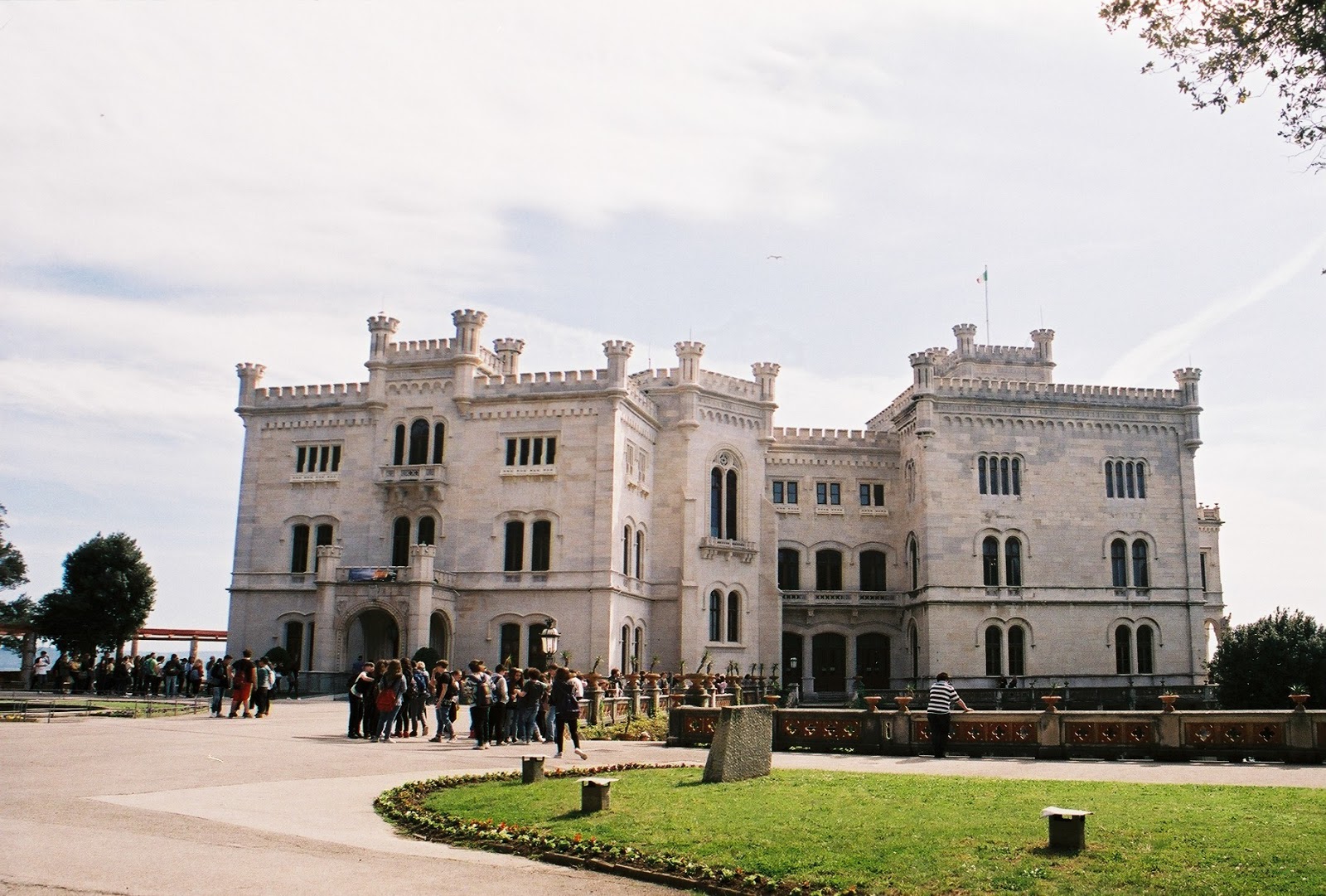
Miramare Castle


The thing with interesting and beautiful things in your near-immediate vicinity is that it takes a lot of willpower and organisation to finally get to pay it a visit. Whenever I'm discussing the next daytrip with my sister, things like the Miramare castle are brushed off for being too close i.e.: "We can go there anytime." And 'anytime' never comes. This time, however, I've managed to beat the paradox with the aid of some student discounts, which enabled us to pay 1€ for 2 tickets(!). The day was excruciatingly hot, but we managed. Instead of possibly giving out the wrong information, I've instead simply posted the information from the official Miramare castle site.


The Castle of Miramare and its Park were built by order of Ferdinand Maximilian of Hapsburg who decided to have a residence befitting his rank built on the outskirts of Trieste, facing the sea and surrounded by a large garden. Struck by the tough, untamed beauty of the promontory of Grignano – a sheer Karst outcrop, then almost devoid of vegetation – Maximilian purchased several plots of land at the end of 1855. The laying of the foundation stone took place on 1st March 1856.

The style reflects the artistic interests of the Archduke, who was acquainted with the architectural style of the time which was mainly eclectic: Gothic, Medieval and Renaissance models combine in a remarkable blend, recalling other examples of the great houses of the time, built by noblemen in Alpine landscapes on the banks of rivers and lakes.

In Miramare Castle, Maximilian creates a perfect combination of the sweet scent of the Mediterranean and the austerity of European form, recreating a unique atmosphere thanks to the presence of the sea, which gives the light-blue colours to the tapestry on the ground floor of the Castle, and inspires the names and furnishings of many of the rooms.
(taken from here)

 What's the last place you've been to?

x, Valens